Porch, bay and rear-addition roofs that hold water
Flat and Low-Slope Roofs in Warren, NJ
Flat and low-slope roof repair in Warren, NJ starts with where the water goes and where it sits, since these roofs shed it slowly.
Call (908) 827-6709, describe the section over the porch, bay or addition and any pooling after rain, and the contractor can talk through what a visit can look at.
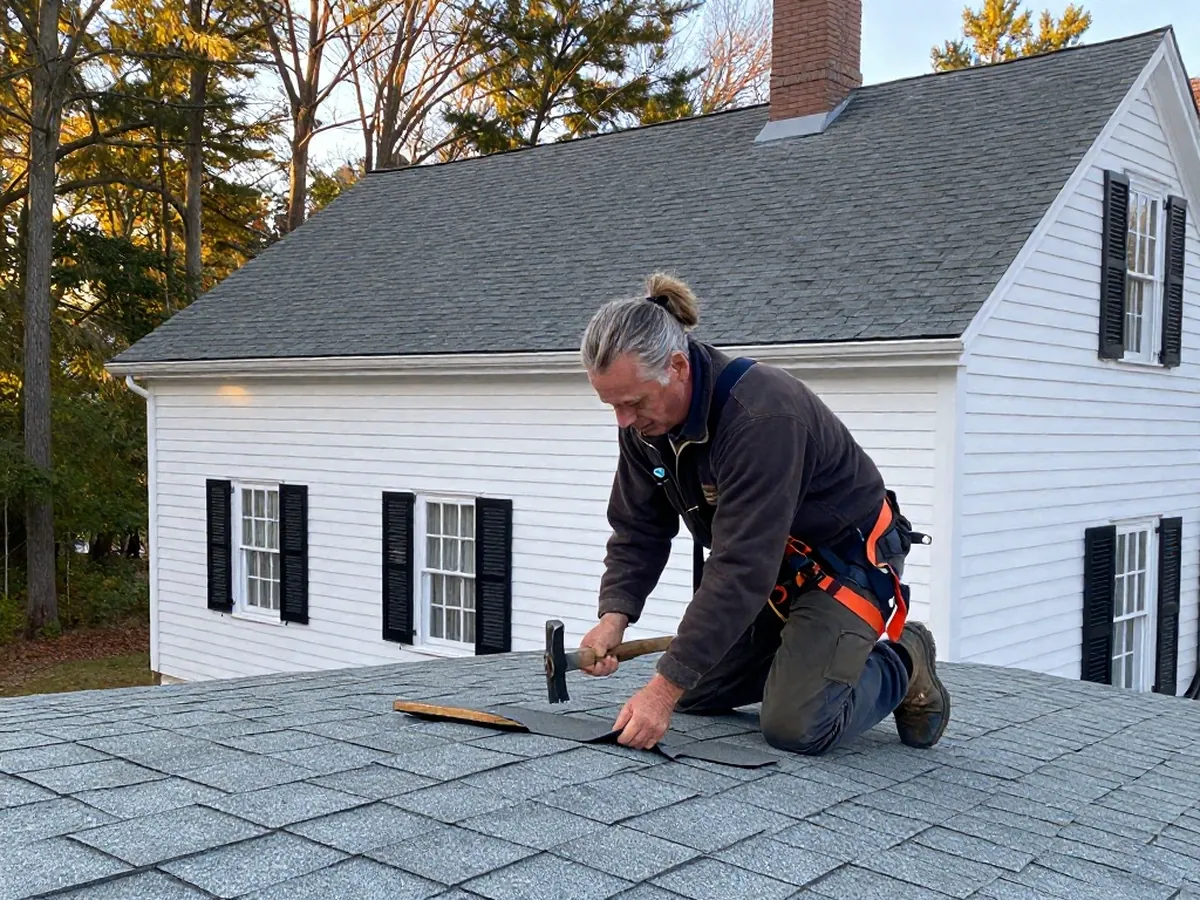
What the contractor can look at
Call (908) 827-6709 and say where the flat section sits and where water appears; the contractor can set up a visit.
- The contractor can read how the surface falls toward its drain, scupper or gutter, and mark where the water stops short.
- Seams, edge metal and the line where the flat roof meets a wall can be checked for gaps and lift.
- Soft spots underfoot can be pressed to learn whether wet material is sitting under the surface.
- A patch, a recoat and a replacement can be laid out side by side, with the one that matches what was found.
- The written scope can name the material, the drainage steps, and the start and finish dates.
Looks from the ground
Stick to what the lawn, an upstairs window or the attic hatch shows. A ladder, or a walk over the shingles, is a roofer's job.
- A day after rain, look down on the flat section from an upstairs window. Water still lying in a shallow patch marks a spot that does not drain.
- Check the drain, scupper or gutter at the low edge. Leaves, seed pods and shingle grit collect there first.
- Look at the metal along the edges for a curl, a gap or a strip that has lifted. FEMA's low-slope sheet says edge metal often fails by lifting.
- Under the flat section, look at the ceiling and the wall tops for faint brown stains, and press nothing that feels soft.
Step back and get help if
- A ceiling beneath a flat section that bulges or sags: empty the room below and call 911. Standing water is heavy.
- A wire lying near the roof edge or dangling from the pole: stay well back, at least 30 feet, and alert 911 or your electric company (PSE&G 1-800-436-7734, JCP&L 1-888-544-4877).
- Water showing at a light or an outlet under the roof: leave that room, and from somewhere dry, call 911.
- Walking out on the roof to sweep off water, leaves or snow: do not. A wet membrane is slick and a soft patch can give way. Call 911 if someone falls.
Questions to put to a roofer
Ask about the low spot before any quote is signed
Ask where the water will leave once the work is finished: a drain, a scupper or a gutter, and what happens if that opening clogs. Ask what the plan is for the exact patch where water stood before.
Ask what the surface material is, how the seams are joined and how the edges are finished. Ask for the answers in the written scope, so the drainage plan is part of the paperwork and not a remark made on the porch.
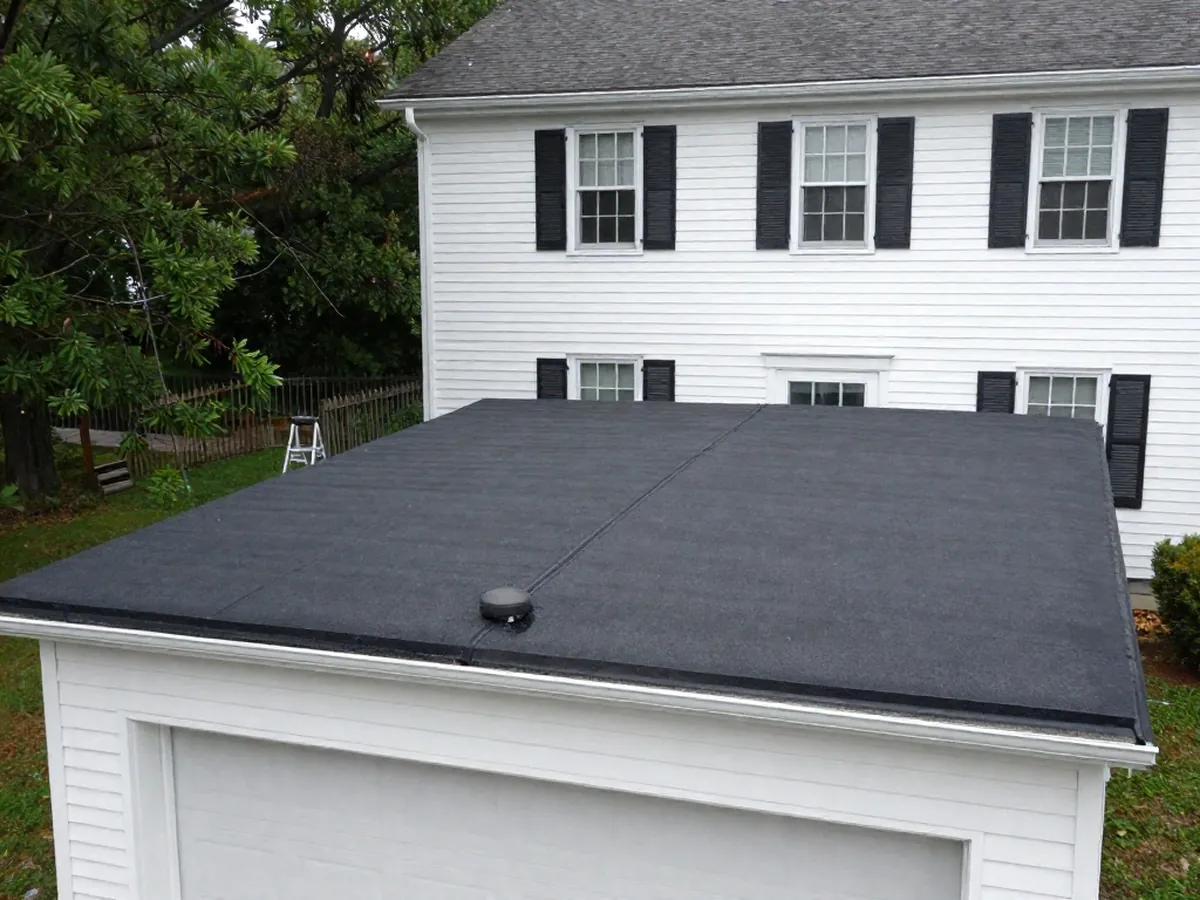
About the picture
In the picture: a black membrane, a seam and a drain
The scene shows a flat roof over a rear family-room addition, with a pitched shingle roof rising behind it. A black rubber membrane covers the surface, one seam runs across it, and a round drain sits at the low point with a few oak leaves gathered around it.
That drain is the exit the water is meant to use. The picture is a rendering, not a photograph of a real roof.
Questions this job raises
How serious is standing water on a flat roof, from 1 to 10?
A ceiling sagging under standing water, water at a fixture or a downed wire is an 8 to 10: get clear and reach 911 or the utility before anything else. Water that sits on the roof for days, or a stain that keeps growing, is a 4 to 7, so call (908) 827-6709 this week. A puddle that clears by the next day with nothing showing inside is a 1 to 3: photograph it and watch.
Why does water sit on a flat roof?
FEMA's low-slope fact sheet describes three ways such a roof sheds water: interior drains, gutters or scuppers, and an overflow route if the first ones clog. A blocked drain, a low spot in the surface or a missing overflow lets it pool. The same sheet calls a reroof the moment to deal with ponding.
How frequently does a flat roof call for inspection?
FEMA advises a check twice a year, usually spring and fall, and again after high wind. A low-slope roof gives leaves and debris a place to stay, so the drain gets the first glance.
Which part of a flat roof gives out first?
The fact sheet points to the edge. Edge metal often fails by lifting, and once wind gets under it the membrane behind it is exposed. A curled strip that looks minor from the yard is worth a photograph and a call.
Is flat roof work available outside Warren?
Yes. The contractor takes calls from Warren roofing, Watchung roofing, Green Brook roofing, Bridgewater roofing, Bernards roofing and Long Hill roofing. Call (908) 827-6709 with the street address and say what sits under the flat section.
Parts of the roof involved
A flat roof is a shallow tray with a way out
Picture a baking sheet with one low corner. The surface is the tray, and water only leaves if the corner has an opening that stays clear. FEMA names the openings as interior drains, gutters or scuppers, with an overflow route behind them.
The edges finish the tray. Metal along the perimeter holds the membrane down against wind, and the line where the roof meets a taller wall needs its own flashing, since two surfaces meet there.
Paperwork, briefly
Flat roofs and the state's maintenance wording
The state's ordinary-maintenance alert mentions roof covering on a detached single-family or two-family dwelling, and its wording makes no split between flat and pitched. A detached garage or shop, or an attached home, may be treated differently by the town. Each office is listed on the hiring checklist.
Where this comes from (7)
- FEMA, Fact Sheet 3.3.2: Roof Systems, Low-Slope Roofs
- FEMA, Fact Sheet 3.3.1: Roof Systems, Sloped Roofs (Mar 2022)
- U.S. Department of Energy, Building Science Education, Water-managed roof assembly
- NJ Department of Community Affairs, Ordinary Maintenance and Minor Work alert (5 Mar 2018)
- NIOSH, Ladder safety (reviewed 1 Mar 2024)
- PSE&G, Downed power lines
- FirstEnergy, Downed power lines
Checked 1 Nov 2026
Have these ready
Start with the street address, the room that shows water and a guess at the roof's age, then call (908) 827-6709. Renters can pass their photos to the owner, who arranges roof work.