Ridges of ice at the eave and drips in midwinter
Ice Dams and Winter Leaks in Warren, NJ
Ice dam and winter leak help in Warren, NJ starts with why snow melts on one part of the roof and refreezes on another, and what that does to the eaves and ceilings below.
Call (908) 827-6709, describe the ridge of ice or the drip, and the contractor can talk through the next steps.
What the contractor can look at
Call (908) 827-6709 and describe where the ice builds and where water appears indoors; a visit can follow.
- The attic floor can be checked for air leaks at hatches, light fixtures and chimney chases, which University of Minnesota Extension names as often the main heat source.
- Insulation depth and the vents at the eaves and ridge can be looked at.
- The eaves can be examined for water damage to shingles, boards and soffits.
- The contractor can say whether an eave membrane is part of the roof and what adding one would involve.
- The written scope can separate this season's stopgap from longer-term work done in warmer weather.
Looks from the ground
Stick to what the lawn, an upstairs window or the attic hatch shows. A ladder, or a walk over the shingles, is a roofer's job.
- From the ground, look along the lowest edge for a ridge of ice and for icicles that are thick rather than thin. Note which side of the house they cling to.
- Look at the soffit, the wall under the eave and the ceilings along outside walls for brown stains or peeling paint.
- Peek into the attic from the top of the ladder in daylight, looking for frost on the roof boards, gaps around the hatch and bare patches in the insulation.
- Photograph the ice, the stains and the date. A before-and-after set helps in a later talk with a roofer or an insurer.
Step back and get help if
- Ice or snow that can slide off an edge: keep people, pets and cars clear of the drip line. Falling ice is a hazard.
- A ceiling that bulges or keeps dripping after a thaw: do not stand beneath it; call 911.
- A wire pulled loose by ice or a falling limb: hold at least 30 feet off, assume it is live and get word to 911 or your electric company (PSE&G 1-800-436-7734, JCP&L 1-888-544-4877).
- Climbing onto a snowy roof, or chopping at the ice with a hatchet or shovel: do not. Chopping damages shingles and a fall is the bigger risk. Call 911 if someone is hurt.
Questions to put to a roofer
Questions that tell a cure from a cover-up
Ask whether the plan reduces the heat reaching the roof or only treats the ice that is already there. Ask who will seal the air leaks in the attic, and whether that is in the quote.
Ask which parts of the work wait for dry weather, and what holds in the meantime. Ask for the answers in writing, with the dates for the stopgap and the dates for the rest.
About the picture
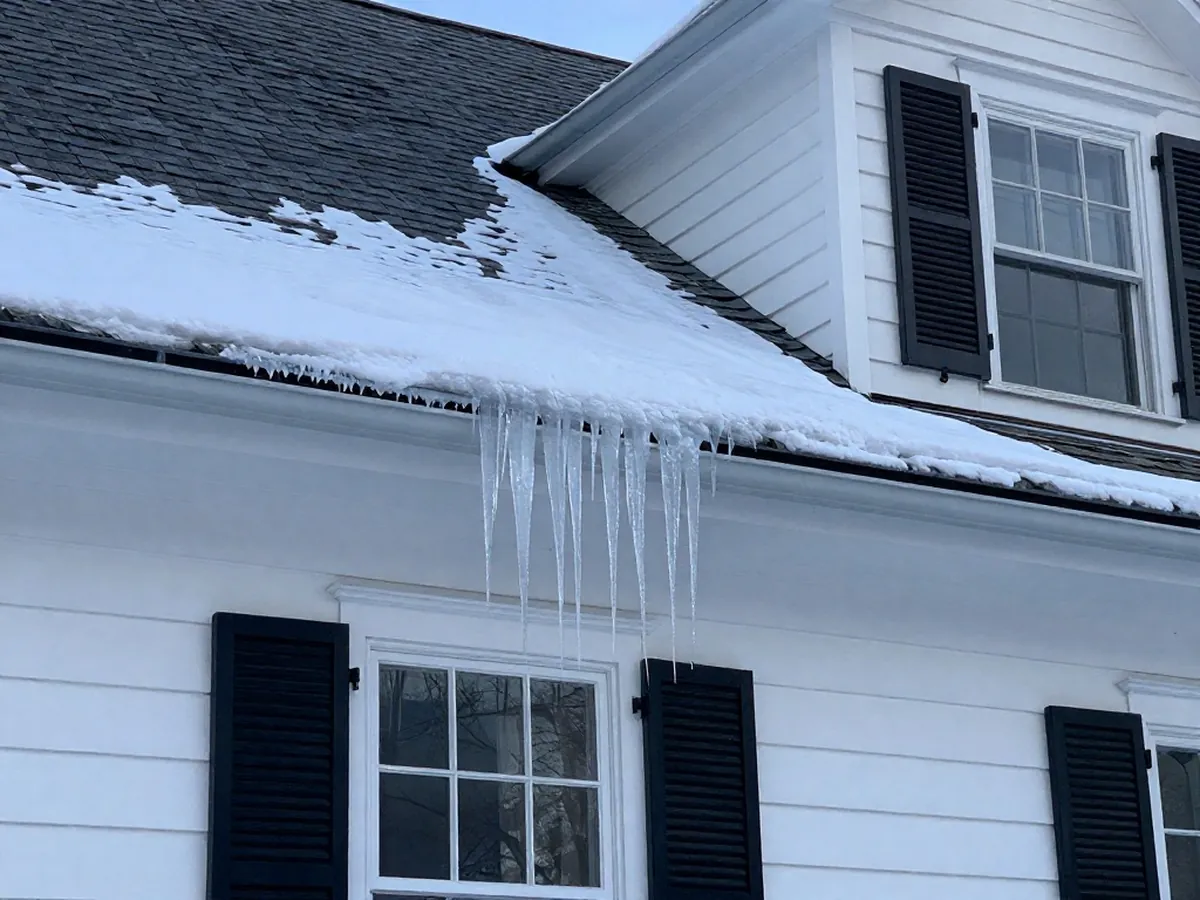
In the picture: a ridge at the eave and a stain on the soffit
The scene shows a colonial roof under snow. A thick ridge of ice runs along the lowest edge, long icicles hang from the gutter, and a faint brown stain shows on the soffit board below. The ridge is where the meltwater stops, and the stain is where it found a way through.
This scene is a rendering and does not show a real house.
Questions this job raises
Rate an ice dam from 1 to 10: how soon does it need attention?
Water dripping through a ceiling, a ceiling that bulges or a downed wire is an 8 to 10, so get clear and reach 911 or the utility. A ridge of ice at the eave with a stain just starting is a 4 to 7; call (908) 827-6709 this week. Icicles alone, with nothing showing inside, are a 1 to 3: photograph them and watch through the next thaw.
What makes an ice dam form on a roof?
University of Minnesota Extension traces it to uneven roof temperatures. Heat escaping from the house warms part of the roof, snow melts there, and the meltwater flows down to the cold overhang, where it freezes. Its advice is to seal the air leaks first and add insulation second.
Can I clear it myself with a roof rake?
The same Extension page says a roof rake may damage the roofing, and it recommends hiring professionals for roof work in winter. From the ground, the useful job is watching and photographing; the rest can wait for a crew with the right footing.
Does this part of New Jersey get cold enough for ice dams?
At Somerville airport, about 8.6 miles away, the January normal is 29.9°F, with about 124 days a year when the low reaches freezing and about 17 when the high stays there. The state's 2007 ice-barrier bulletin uses a January average of 25°F or less and names only Sussex County in New Jersey, so ask a roofer about an eave membrane.
Is winter leak help available outside Warren?
Yes. The contractor covers Warren roofing, Watchung roofing, Green Brook roofing, Bridgewater roofing, Bernards roofing and Long Hill roofing. Call (908) 827-6709 with the street address and say where the ice sits.
Parts of the roof involved
Warm above, cold at the edge, and what runs between
Think of a cold drink on a warm table: the glass sweats where the two meet. A roof does something close. Heat from the rooms below climbs into the attic and warms the boards, and snow on the warm part melts. The water runs downhill until it reaches the overhang, which has no heat under it, and freezes.
The ridge grows with each cycle and backs the next melt up under the shingles. That is why Extension starts with air sealing and insulation, and why the Department of Energy describes a self-sealing membrane laid at the eaves as a second line of defense.
Paperwork, briefly
Winter work and the dates in a written contract
A winter job is the kind where weather moves the calendar. The state's home improvement contract rule asks for start and finish dates in the written contract, and for any change to be put in writing too. The hiring checklist goes through the rest.
Where this comes from (8)
- University of Minnesota Extension, Dealing with and preventing ice dams
- U.S. Department of Energy, Building Science Education, Installing self-sealing membrane at eaves
- NJ Department of Community Affairs, Bulletin 07-3 (May 2007, revised Jun 2015)
- NOAA National Centers for Environmental Information, 1991-2020 monthly normals, Somerville Somerset Airport (USW00054785)
- Cornell LII, N.J.A.C. 13:45A-16.2, Home improvement contracts
- Asphalt Roofing Manufacturers Association, Assessing roof damage after Superstorm Sandy (7 Nov 2012)
- PSE&G, Downed power lines
- FirstEnergy, Downed power lines
Checked 1 Nov 2026
Have these ready
Start with the street address, the room that shows water and a guess at the roof's age, then call (908) 827-6709. Renters can pass their photos to the owner, who arranges roof work.